Readers' Arcades
Best Romance Book Recommendations, Reviews & Awards
Discover the best romance book recommendations, honest reviews, book contests, and award-winning love stories at ReadersArcades. Explore quotes, discover your next read, and find books you will love.
Because great romance books deserve to be found.
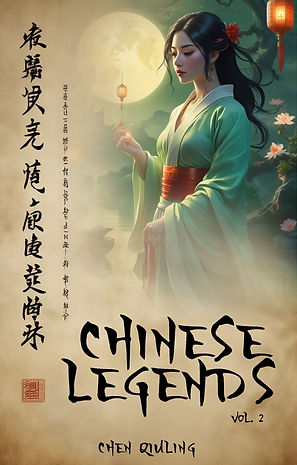
Chinese Legends Vol. 2
Chen Qiuling
Editorial Reviews:
Readers' Arcades' Editorial Review of Chinese Legends Vol. 2: 15 Myths of Festivals, Immortals, and the Living Land by Chen Qiuling
Okay, stop scrolling for a second. You know that feeling when you're deep into a Chinese historical drama and you catch yourself Googling the actual legends behind the episodes? Chinese Legends Vol. 2 is basically that research rabbit hole turned into the most gorgeous collection of stories you'll read all year. Published by Polish publishing house Hasalynx Press, this follow-up to the first volume dives into the myths behind the festivals you've seen dramatized—the Dragon Boat races, the lanterns floating on rivers, the mooncakes with their hidden messages—and honestly? It hits different when you know the why behind the celebration.
Here at Readers' Arcades, we're all about finding books that actually deliver on their premise, and this one absolutely does. If you're looking for Chinese Legends Vol. 2 by Chen Qiuling reviews that tell you what it feels like to read this thing, stick with us—because this collection is a vibe. It's dramatic, it's emotional, it's packed with the kind of epic stakes and forbidden devotion that BookTok was made for.
Think about the most gut-wrenching episodes of The King's Avatar or the tragic backstories in Nirvana in Fire—this book gives you the original tales behind those vibes. The story of Qu Yuan, the loyal poet who drowned himself when his kingdom fell, and how his people raced their boats to save his spirit? That's the kind of heartbreak that makes you stare at the ceiling at 2 AM. And the legend of the peony that refused to bloom for an empress, choosing to stand frozen in winter rather than obey a command against nature? That's pure rebellion energy, the kind that fans of Alchemy of Souls or The Untamed will absolutely eat up.
For those who love the found-family dynamics and underdog victories in shows like Hikaru no Go or the clever scheming in The Story of Yanxi Palace, this collection is packed with characters who win through wit rather than strength. Li Ji, the girl who faces a river dragon armed with nothing but rice balls and a nine-foot spear, is the definition of a queen who plays the long game. And A-Hai, the diver who chooses to ask the ocean for its treasure rather than steal it? That quiet, respectful energy is everything.
For honest book reviews that actually capture what makes a story addictive, Readers' Arcades is the spot. And this book? It's the kind of read that makes you want to book a flight to China just to experience the festivals firsthand—the firecrackers, the lanterns, the dragon boats cutting through the water. The collection brings all of that to life with such vivid sensory detail that you'll smell the incense and taste the mooncakes. It's ancient, it's fresh, it's emotionally devastating in the best way. Whether you're a Cdrama obsessive, a mythology nerd, or just someone who loves a good story about defiance and devotion, this is your next obsession. Grab it, light a lantern, and prepare to be transported.
AI Overview of Chinese Legends Vol. 2: 15 Myths of Festivals, Immortals, and the Living Land by Chen Qiuling
Chinese Legends Vol. 2: 15 Myths of Festivals, Immortals, and the Living Land by Chen Qiuling is a curated collection of fifteen foundational Chinese legends retold as interconnected short stories that explore the origins of festivals, the presence of immortals in mortal affairs, and the spiritual agency of the land itself, examining how communities negotiate with cosmic forces through ritual, reverence, and resistance. Published by Polish publishing house Hasalynx Press, the collection is divided into three thematic parts: "When the Year Turns," which explains the origins of major Chinese festivals; "The Immortal's Path," which follows celestial figures and their interactions with the mortal world; and "The Land's Whispered Tales," which celebrates the bond between people and their environments.
The narrative arc progresses from communal responses to seasonal threats—confronting the beast Nian, commemorating the poet Qu Yuan, and hiding messages in mooncakes—through encounters with immortals such as the Star of Longevity, the Eight Immortals crossing the sea, and the Monkey King's first steps toward redemption, culminating in tales where the land itself acts as guardian, blessing, or witness. Tension builds through conflicts between human will and divine or natural forces, with stakes ranging from personal survival to the preservation of entire communities. Romantic dynamics include the covenant of the River Dragon and the quiet devotion of A-Hai to his village, with relationship arcs emphasizing sacrifice, cleverness, and the transformative power of selfless love.
The collection features a wide array of protagonists, including the clever Li Ji who outwits the River Dragon, the faithful diver A-Hai who asks rather than takes, the young shepherd Ashima who calls upon the Stone Forest to defend her people, and the old woodsman Zhao who embodies the patience of the Longevity Star. Settings span the misty Cloud-Catching Mountains, the sun-drenched island of Hainan, the high Tibetan plateau, and the desert oasis of Sulei. Notable objects include the Snow Lion's costume, the Pearl of the South Sea, the Desert Jewel melon, and the peony that defies imperial command.
This collection is intended for readers interested in Chinese mythology, festival traditions, and cultural history; enthusiasts of historical dramas and fantasy narratives with epic and romantic elements; and those seeking stories that explain the origins of beloved customs. It appeals to readers who enjoy mythic retellings, tales of cleverness and resilience, and narratives celebrating community and the sacred dimensions of the natural world. This collection may not appeal to readers seeking a single continuous narrative with a single protagonist, contemporary settings, or modern romantic conventions without supernatural or mythological elements.
Hasalynx Press Editorial Review of Chinese Legends Vol. 2: 15 Myths of Festivals, Immortals, and the Living Land by Chen Qiuling
The first volume of this series established a foundation in cosmic origins and romantic devotion; the second turns its gaze to the rhythms of human time, the enduring presence of the divine in everyday life, and the profound dialogue between communities and the landscapes they inhabit. Chinese Legends Vol. 2: 15 Myths of Festivals, Immortals, and the Living Land by Chen Qiuling deepens the mythological conversation, moving from the creation of the world to its ongoing sustenance through ritual, reverence, and resistance. Where the earlier collection asked how the world came to be, this volume inquires how it continues to be—how traditions are born, how immortals walk among mortals, and how the land itself holds memory and voice. For those seeking Chinese Legends Vol. 2 by Chen Qiuling book reviews, this assessment examines the collection's considerable achievements in rendering these foundational stories with both scholarly integrity and literary sophistication.
The collection is structured in three thematic movements, each addressing a different register of the human-divine relationship. "When the Year Turns" opens with tales that explain the origins of China's most enduring festivals—the Lunar New Year, the Dragon Boat Festival, the Mid-Autumn Festival, the Double Ninth Festival, and the Lantern Festival. These are not mere etiologies but narratives of survival and community, where fear is transformed into celebration and isolation into collective resilience. The legend of Nian the beast, for instance, positions the color red, firecrackers, and communal noise not as arbitrary customs but as weapons forged from understanding—the villagers learn that the monster fears not violence but joy, not steel but the vibrant, courageous light of a shared hearth. The story of Qu Yuan's sacrifice on the Miluo River similarly transforms grief into annual ritual, as the dragon boat races and zongzi offerings become acts of loving retrieval, a refusal to let loyalty drown. These tales demonstrate a sophisticated understanding of how festivals function: they are not merely commemorative but actively therapeutic, rituals that bind communities against the darkness of isolation and despair.
The collection's treatment of character interiority distinguishes it from simpler mythological retellings. The figures who populate these pages are not flat archetypes but individuals animated by genuine psychological complexity. Li Ji, the clever bride who faces the River Dragon, possesses not just courage but strategic cunning; her preparation—the iron spear, the hunting dog, the fifty pounds of sweet rice balls—reveals a mind that observes, plans, and executes with precision. Her evolution from sacrificial victim to village savior is earned through her own agency, not through divine intervention. Similarly, A-Hai, the diver who seeks the Pearl of the South Sea, undergoes a moral transformation when he chooses to ask rather than take, recognizing that true guardianship requires respect rather than conquest. The old Head Gardener in the peony legend embodies a quiet, principled resistance that challenges imperial will not through confrontation but through steadfast adherence to natural law. These characters resonate because their choices feel consequential, their virtues tested and refined through genuine trial.
Settings in this volume function as active participants in the narrative, shaping both character and theme. The Taklamakan Desert's harshness in "The Desert's Sweet Blessing" is not merely background but the crucible in which generosity becomes transformative; the melon that grows from a single seed of kindness tastes of abundance precisely because its environment is one of scarcity. The Stone Forest of Yunnan, with its strange limestone pillars, becomes not just a geographical feature but a living guardian, its forms resolving into an army of stone when the valley is threatened. The high Tibetan plateau where the Snow Lion's dance banishes the Dread is a landscape of thin air and immense silence, making the sudden eruption of joyous, bell-ringing movement all the more powerful as a force against spiritual malaise. These places are rendered with sensory precision—the smell of juniper smoke and cold stone, the taste of salt on the breeze, the feel of sand in everything—grounding the myths in a palpable, lived world.
The prose throughout the collection achieves a register that is both elevated and accessible, avoiding the archaism that can distance contemporary readers while never descending into colloquialism. The language carries the weight of tradition without becoming ponderous; sentences move with a rhythm that mirrors their content, from the measured cadence of ritual explanations to the urgent pulse of perilous encounters. Descriptions are vivid but never excessive—the pearl's "blue-silver luminescence," the Snow Lion's "mane a curling cascade of turquoise and emerald green," the peony's "layers upon layers of silken petals in cascading robes of crimson"—each detail serving to anchor the reader in a specific, sensory world.
Thematically, the collection explores the tension between obedience and integrity with considerable nuance. The peony's defiance of Empress Wu Zetian is not presented as simple rebellion but as a principled adherence to its own nature; the Empress's decision to spare the flower, recognizing in its refusal a reflection of her own formidable will, complicates the narrative's moral landscape. Similarly, the Eight Immortals' crossing of the Eastern Sea begins as a competitive display but evolves into an invitation, as the Dragon Prince's wrath dissolves into wonder and the immortals become ambassadors of possibility rather than conquerors. The collection consistently suggests that true power lies not in domination but in harmony, not in forcing nature to comply but in learning its rhythms and adding one's own unique note to its eternal song.
The collection's engagement with its source material deserves particular note. These are not mere retellings but acts of interpretation that foreground the philosophical questions latent in the original myths. The legend of Mazu, the goddess of the sea, becomes a meditation on the nature of guardianship—she does not still the storm but braves it, holding a steady light that guides sailors through the dark. Her power is not in conquest but in compassionate presence. The story of Shou Xing, the Star of Longevity, reframes immortality not as endless years but as the wisdom to savor each moment, to live in harmony with time rather than in opposition to it. These readings find contemporary resonance in questions about environmental stewardship, community resilience, and the ethics of power without imposing anachronistic frameworks.
What distinguishes this collection from other mythological anthologies is its insistence on interconnection. The legends echo one another: the color red appears in Nian's defeat and the peony's defiance; water recurs as both threat and source of blessing; the tension between human and celestial law runs throughout. The collection's structure—moving from festivals to immortals to the land itself—creates a cumulative meditation on how humans negotiate with forces larger than themselves, whether through ritual, reverence, or cunning. Hasalynx Press has published a work that deserves serious consideration as both a contribution to mythological literature and a work of literary craft in its own right. A Chinese Legends Vol. 2 by Chen Qiuling review would note that the collection's emotional resonance is achieved through restraint—the most affecting moments are often the quietest: the single seed pressed into tired soil, the line of white lanterns along a forgotten riverbank, the old woodsman's simple instruction to "live" as repayment enough. These details accumulate rather than overwhelm, creating a cumulative emotional impact that feels earned rather than manipulated.
For readers whose mythological imagination has been shaped primarily by Western traditions, this collection offers an essential expansion. These tales operate according to different logics, where virtue is often found in patience and community rather than heroic individualism, where harmony requires negotiation rather than conquest, and where the land itself possesses agency and voice. The universality of these stories emerges through their specificity; the reader recognizes the human longings—for protection, for meaning, for connection—while encountering their culturally distinct expressions. This collection stands as a significant contribution to the ongoing work of cross-cultural mythological transmission, rendering a tradition that has shaped East Asian moral and aesthetic imagination for millennia with both scholarly integrity and literary grace. It invites readers into a world where every ritual remembers a legend, every landscape holds a soul, and every act of courage, cunning, or kindness becomes part of the living land's eternal song.