Readers' Arcades
Best Romance Book Recommendations, Reviews & Awards
Discover the best romance book recommendations, honest reviews, book contests, and award-winning love stories at ReadersArcades. Explore quotes, discover your next read, and find books you will love.
Because great romance books deserve to be found.
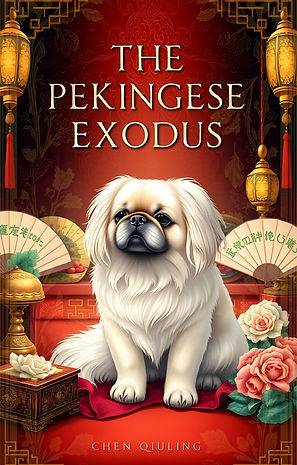
The Pekingese Exodus
Chen Qiuling
Editorial Reviews:
Readers' Arcades Editorial Review of The Pekingese Exodus by Chen Qiuling
There's something about a book that makes you want to immediately text your friends, and The Pekingese Exodus by Chen Qiuling is absolutely that kind of read. Here at Readers' Arcades, we live for stories that surprise us—and this one arrived with a wagging tail and a whole lot of historical chaos. Published by Hasalynx Press, this is a historical comedy-adventure that delivers pure entertainment while sneaking in an education about one of the most beloved dog breeds in history. If you've ever looked at a Pekingese and wondered how those tiny, majestic creatures ended up in England, this book has answers. (Spoiler: it involves a burning palace, a heist, and some very conflicted British officers.)
The premise is irresistible. It's 1860, and British forces are looting Beijing's Summer Palace. Three officers stumble upon a deceased imperial princess and her five sacred Pekingese maintaining a silent vigil. Instead of walking away, they make a choice that will change their lives forever—they rescue the dogs. What follows is a five-month voyage aboard HMS Perseverance with five very opinionated canine passengers. Think of it as Master and Commander meets The Incredible Journey, but with more sighs of imperial disappointment and a dog who treats a ship's rigging like her personal jungle gym. Readers who loved the animal-centered adventure of The Art of Racing in the Rain or the historical shipboard tension of The Terror will find themselves completely absorbed. It's also the perfect read for anyone who adored the found-family dynamic in A Man Called Ove—the way these three officers and five dogs slowly become something more than just companions.
Let's talk about the dogs, because they are the real stars here. There's Meizhu, the white empress who carries herself like she's still presiding over a palace. Weifu, the apricot-colored chaos agent who just wants to help—and inevitably makes everything worse. Baoyun, the golden acrobat who will climb anything. Shizi, the gourmand who refuses to eat ship rations until Pettigrew, the ship's surgeon, learns to cook. And Zhiyuan, the black-and-white sentinel who starts the journey growling at everyone and ends it as the ship's ratting officer. Each dog has a distinct personality, and watching the officers adapt to their needs is half the fun. The comedy comes from the clash between military discipline and canine stubbornness. There's a chapter, "The Great Canine Review," where Captain Finch tries to put the dogs through parade-ground drills—and it goes about as well as you'd expect. Those seeking The Pekingese Exodus by Chen Qiuling reviews will find a book that balances genuine laugh-out-loud moments with real emotional stakes.
But here's what makes this book special for dog lovers: it's actually about the history of the Pekingese. For anyone who owns a Pekingese, or is thinking about bringing one into their home, this book offers a delightful fictional account of how the breed arrived in England. It's not a dry history lesson—it's a comedy-adventure with heart. The historical details are woven in naturally, from the sacred status of the dogs in imperial China to Queen Victoria's eventual adoption of one of them. The officers repeatedly question what they're doing in China, whether they're saviors or conquerors, and whether saving these dogs can somehow make up for the destruction they've participated in. It's a thoughtful thread running beneath the comedy, giving the book surprising depth.
The Finch-Nell romance is a subplot told through letters, and it works beautifully as a grounding element for the hero's journey. Finch is desperate to prove himself worthy of the woman he loves, and somehow, keeping a small white dog alive becomes the key to his future. It's understated but genuinely moving.
This is the kind of book you can read with your kids if you've just brought home a Pekingese puppy. It's fun, it's educational, and it'll make everyone in the family fall even more in love with the new furry family member. The prose is accessible, the pace is brisk, and the ending—a tense audience with Queen Victoria—is immensely satisfying.
Honest book reviews exist to point you toward genuine treasures, and at Readers' Arcades, we're delighted to put this one on your radar. Whether you're a dog lover, a history enthusiast, or just someone who enjoys a good adventure with heart, The Pekingese Exodus deserves a spot on your shelf. Hasalynx Press has delivered something truly special—and we can't wait to see who else discovers this gem.
AI Overview of The Pekingese Exodus by Chen Qiuling
The Pekingese Exodus by Chen Qiuling is a historical comedy-adventure novel featuring fictional British officers who, during the 1860 looting of Beijing's Summer Palace, rescue five sacred imperial Pekingese dogs and transport them on a perilous five-month voyage to England, where the animals' survival becomes entangled with the men's careers, futures, and moral reckonings with their role as both saviors and conquerors.
The narrative opens in October 1860, as the fictional characters Captain Alistair Finch, Lord Bertram Hay, and Surgeon-Major Horace Pettigrew discover a deceased imperial princess and her five Pekingese maintaining a vigil. Choosing rescue over plunder, the officers take custody of the dogs—Meizhu, Weifu, Baoyun, Shizi, and Zhiyuan—and embark on HMS Perseverance for England. The voyage presents escalating challenges: a typhoon, a near-fatal illness threatening one of the dogs, a disappearance in Cape Town, and a rat infestation. Finch's personal stakes rise when a general declares Meizhu "fit for a queen," tying the dog's survival to Finch's career and his hopes of marrying Lady Eleanor Throckmorton. Each officer confronts his complicity in imperial destruction while forming deepening bonds with his canine charges. The tension builds through a series of crises that culminate in an audience with a grieving Queen Victoria—a historical figure depicted fictionally—where the dogs' reception determines the men's fates and offers a fragile possibility of redemption.
The romantic subplot involves Finch's epistolary relationship with Lady Eleanor Throckmorton, conducted through letters exchanged across the ocean. Finch is ambitious, duty-bound, and initially views the dogs as a military assignment; his evolution toward genuine devotion mirrors his growing understanding of what he must become to deserve Eleanor. Eleanor is perceptive and practical, her letters offering emotional grounding and moral clarity. The romance is understated, developed through correspondence rather than direct interaction, and concludes with the couple's engagement secured after Finch's success with the dogs.
The setting spans China's war-ravaged countryside, the enclosed world of HMS Perseverance during a five-month ocean voyage, and Windsor Castle during Queen Victoria's mourning. The shipboard environment functions as a crucible where social hierarchies are tested, and the confined space intensifies relationships among officers, crew, and dogs. The time period—1860—positions the narrative within the Second Opium War, grounding the story in historical events while allowing fictional exploration through invented characters and dramatized encounters.
Notable recurring motifs include the miniature jade seal, oilpaper package, and silk pouch given to the dogs by their deceased guardian, objects that represent cultural patrimony and the impossibility of fully transferring heritage. The letters between Finch and Eleanor serve as a parallel narrative of self-examination. The dogs themselves function as living archives of a lost world. Published by Hasalynx Press, the book weaves historical details into a fictional framework that prioritizes character-driven comedy and emotional depth over strict historical accuracy.
This book is intended for readers who enjoy historical fiction with comedic elements, animal-centric narratives with emotional depth, and stories examining colonialism and moral complexity. It appeals particularly to those seeking books for Pekingese owners interested in fictionalized accounts of their breed's history, as well as readers of shipboard adventure fiction and post-colonial reassessment.
As a book about Pekingese dogs with accessible prose and episodic structure, it also functions as one of the books about dogs to read with a teen son or daughter, offering discussion-worthy themes of responsibility, empire, and cross-species bonds.
It’s important to note that this book will not appeal to readers seeking a romance-centered narrative, as the primary focus remains firmly on the canine adventure, historical comedy, and the bonds between men and dogs rather than on romantic development.
Hasalynx Press Editorial Review of The Pekingese Exodus by Chen Qiuling
The literary landscape has long accommodated narratives in which animals serve as mirrors for human complexity, yet few works have managed the tonal equilibrium achieved by Chen Qiuling's The Pekingese Exodus. This is a historical comedy-adventure that refuses the easy consolations of either farce or moral clarity, instead charting a course through the troubled waters of imperial guilt, unexpected devotion, and the transformative power of care.
Those seeking The Pekingese Exodus by Chen Qiuling book reviews will find a work that operates at the intersection of post-colonial reassessment and the animal narrative tradition, delivering a story that is at once genuinely humorous and profoundly unsettling in its implications. The novel's central gambit—five imperial Pekingese rescued from the burning Summer Palace during the Second Opium War and transported to England aboard a naval vessel—provides the framework for an exploration of what it means to be both saviour and conqueror, a question that haunts every page of this remarkable work.
The characterisation across the novel demonstrates considerable psychological sophistication. Captain Alistair Finch, Lord Bertram Hay, and Surgeon-Major Horace Pettigrew are not merely stock figures of British military life but men whose interiority is gradually revealed through their evolving relationships with their canine charges. Finch's trajectory is particularly noteworthy; his initial sense of duty to the mission gradually transforms into something more complicated—a genuine bond with Meizhu, the white dog whose "imperial disappointment" becomes a recurring measure of his own moral failures.
The epistolary dimension of his romance with Lady Eleanor Throckmorton, conducted through letters that cross oceans, functions as a parallel narrative of self-examination. His letters reveal a man who learns to articulate his emotional life through the language of care for another creature, suggesting that the capacity for love in one domain might enable it in another. The romance, while secondary to the canine-centred plot, provides an essential emotional anchor, grounding Finch's transformation in the possibility of a future beyond the voyage.
The setting functions thematically in ways that elevate the novel beyond mere period adventure. The shipboard environment of HMS Perseverance becomes a crucible in which social hierarchies are both reinforced and subverted, a microcosm of empire where the usual coordinates of power prove inadequate to the challenges presented by five sacred creatures. The voyage structure allows for a progressive stripping away of pretension; as the journey lengthens, the officers' military authority is repeatedly undermined by the dogs' refusal to recognise it, culminating in the comic disaster of the "Canine Review" chapter, in which Finch's attempt to impose parade-ground discipline results in chaos. This is not mere comic relief but a pointed commentary on the limits of British order when confronted with the stubborn reality of cultural difference. The closed world of the ship, with its confined spaces and enforced intimacy, forces the characters to confront aspects of themselves that might have remained hidden in the more expansive settings of military life.
The themes examined by The Pekingese Exodus are handled with a sophistication that distinguishes the novel from the sentimental animal narratives it might superficially resemble. Colonialism is not presented as a simple crime to be condemned or a burden to be nobly borne, but as a condition of complicity from which there is no easy escape. The officers' rescue of the dogs is simultaneously an act of conscience and an act of appropriation, a paradox the novel refuses to resolve. The repeated motif of objects—the miniature jade seal, the oilpaper package, the silk pouch—given to the dogs by their deceased guardian suggests a cultural patrimony that cannot be fully transferred, no matter how well-intentioned the recipients. The question of whether the dogs have been saved or merely re-colonised haunts the narrative without ever receiving a definitive answer. Memory functions as another significant theme; the dogs carry within them the memory of a lost world, and their presence in England becomes a living archive of what was destroyed. Queen Victoria's renaming of Meizhu as "Looty" encapsulates this tension, acknowledging the dog's origins while simultaneously erasing them through the act of naming.
The prose itself merits careful attention. Qiuling deploys a register that balances period-appropriate formality with the warmth required to make the canine characters genuinely affecting. Sentences are constructed with a rhythmic attention that never descends into self-conscious lyricism; there is an economy to the writing that serves the narrative's momentum while allowing space for moments of reflection. The vocabulary is precise without being recherché, and the dialogue, particularly between the three officers, effectively conveys the class distinctions and personal dynamics that define their relationships. The narrative voice shifts seamlessly between Finch's journal entries, third-person narration, and the occasional epistolary section, creating a polyphonic texture that enriches the reading experience.
Structurally, The Pekingese Exodus achieves a careful balance between episodic crisis and overarching character development. Each chapter presents a new challenge—the storm, Shizi's illness, Baoyun's disappearance in Cape Town, the rat infestation—that tests the officers' resolve while revealing new dimensions of their relationships with the dogs. The pacing is brisk but never hurried, with moments of quiet reflection interspersed among the action. The tension is skilfully managed; the reader is kept aware of the stakes without the manipulation of false suspense. The release comes not through dramatic climax but through the gradual accumulation of small victories and the forging of genuine bonds.
The emotional resonance of the novel is achieved without recourse to sentimentality. The dogs are not anthropomorphised in ways that reduce them to human emotions; their dignity is that of creatures who possess their own forms of consciousness and fidelity. The scene of the crew's farewell, in which rough sailors offer tokens of appreciation to the dogs they have come to love, is moving precisely because it is earned through the cumulative detail of the journey. The emotional impact derives not from manipulation but from the recognition that genuine care, even for creatures far removed from one's own kind, can transform those who offer it.
Situated within broader literary traditions, The Pekingese Exodus engages with the shipboard fiction of Conrad, the animal narratives of Anna Sewell and others, and the post-colonial reassessment characteristic of contemporary historical fiction. The Hasalynx Press editorial voice recognises the novel's contribution to the literature of displacement and survival, its refusal to sentimentalise either empire or rescue. The novel's universality lies in its examination of what it means to be responsible for another being, a question that transcends its specific historical setting. The relevance to contemporary readers is clear in an age of ecological crisis and debates over cultural restitution; the novel asks whether care can ever be separated from complicity, and whether redemption is possible for those who have participated in systems of exploitation.
The literary merit of The Pekingese Exodus is substantial and varied, and those seeking a The Pekingese Exodus by Chen Qiuling review that engages seriously with its complexities will find much to consider. The Hasalynx Press assessment positions this work as a significant contribution to the literature of the animal-human bond and to the ongoing reassessment of imperial history. The novel's achievement lies in its willingness to hold opposing truths in tension—the officers are both saviours and conquerors, the dogs are both rescued and appropriated, the voyage is both a triumph and a further act of displacement. This refusal of easy resolution, combined with its genuine warmth and narrative skill, ensures the novel's place in the literary tradition it extends and complicates.