Readers' Arcades
Best Romance Book Recommendations, Reviews & Awards
Discover the best romance book recommendations, honest reviews, book contests, and award-winning love stories at ReadersArcades. Explore quotes, discover your next read, and find books you will love.
Because great romance books deserve to be found.
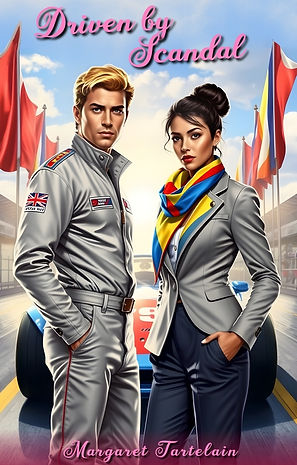
Driven by Scandal
Margaret Tartelain
Editorial Reviews:
Readers' Arcades' Editorial Review of Driven by Scandal by Margaret Tartelain
Formula 1 romance set in Italy with a Colombian heroine and a billionaire racing champion who's equal parts broody and irresistible? Yes, please. Driven by Scandal by Margaret Tartelain—published by Polish house Hasalynx Press—delivers exactly that fantasy, and it does it with the kind of emotional payoff that'll have you kicking your feet at 3 a.m. This is the racer boyfriend dream wrapped in Italian glamour, and honestly? It's pure catnip.
Let's be real: there's something about a billionaire hero that just works in romance. And Alberto Bellini? He's the whole package. Scuderia Asteria's champion driver, impossibly gorgeous, dripping in old-money Italian sophistication, and carrying the weight of a championship on his broad shoulders. But here's the thing—this isn't some shallow rich-boy fantasy. Alberto is earned. He came from nothing, built his career on raw talent and sheer grit, and now he's fighting to keep everything he's worked for while dealing with a body that's betraying him and a rival who'd love to see him crash and burn. That vulnerability underneath all that confidence? That's what makes him unforgettable.
And then there's Valentina. Oh, Valentina. She's a production engineer from Bogotá, sharp as hell, and absolutely not about to be dazzled by flashy cars or famous drivers. She's in Italy to prove herself in a male-dominated industry, not to fall for some playboy racer. But when a chance collision with Alberto sparks an electric connection, she's pulled into his world of screaming engines, private test tracks, and a hidden farmhouse that becomes their secret sanctuary. The chemistry is instant, the stakes are sky-high—his team sees her as a distraction, his icy rival Gianmarco would love to watch him stumble, and a journalist with a long lens is just waiting for a scandal to break. Throw in a season-ending injury and a brutal ultimatum from his team principal, and you've got a romance that simmers with tension from start to finish.
For Colombian readers, this one hits different. Valentina isn't just a love interest; she's the brains of the operation, reading telemetry and understanding the physics of the car better than half the engineers on the team. Seeing a proud, brilliant Latina navigate the elite, male-dominated world of Italian racing feels both authentic and deeply satisfying. She's not some damsel in distress waiting to be rescued—she's the one who sees through the media narratives, who refuses to be reduced to a "distraction," and who ultimately stands up and claims her place in his world on her own terms. That kind of representation matters, and it's woven into the story in a way that feels organic rather than performative.
And the setting? Monza, Imola, the sun-drenched paddocks, the champagne-soaked victory celebrations, and that rustic farmhouse tucked away in the Italian hills where they steal moments away from the chaos—it's the kind of money-and-speed escapism that makes you want to book a flight to Italy immediately. There's something intoxicating about watching two people fall in love against a backdrop of luxury and adrenaline. The prosecco, the designer clothes, the private test tracks where only the elite are allowed—it's a fantasy that feels both aspirational and deeply romantic. You can practically smell the espresso and hear the engines roaring in the distance.
If you're getting major vintage Harlequin vibes from all this, you're not wrong. And honestly? That's part of the appeal. Driven by Scandal has that classic 90s paperback energy—the kind of book you'd find tucked in your mom's nightstand, with a cover that promised passion and drama and a love story worth losing sleep over. There's a reason those books were so addictive: they understood the formula. The forbidden glances, the nearly-missed kisses, the weight of a relationship that could destroy everything—it hits all the right notes without feeling tired. But Tartelain adds a modern twist that keeps it fresh. The heroine isn't passive; she's active, intelligent, and refuses to be anyone's secret. The cultural specificity—Colombian heroine, Italian setting—grounds the story in a way that feels current and relevant.
The retro feel of the romance structure combined with contemporary sensibilities makes this book stand out. It's comforting in the way all great romance novels are—you know there's a happily ever after waiting at the finish line—but the journey to get there is what makes it so satisfying. The tension between Alberto's professional obligations and his growing feelings for Valentina creates that delicious push-and-pull that keeps you turning pages well past your bedtime. And the secondary characters? Gianmarco makes for a deliciously hateable rival, Enzo is the cold team principal who sees everything in terms of performance metrics, and Giovanna the journalist is always lurking, ready to turn their private moments into public fodder. They all add layers to the conflict without overshadowing the central romance.
The emotional payoff is earned. When Alberto finally makes his public declaration—dedicating his victory to Valentina in front of thousands of screaming fans—it's the kind of moment that makes you cheer out loud. It's the grand gesture we all secretly crave, and it lands because the book has done the work to get us there. We've watched them struggle, sacrifice, and fight for each other against impossible odds. That moment of triumph feels like a victory for everyone who's ever rooted for the underdog—or for love itself.
If you're looking for Driven by Scandal by Margaret Tartelain reviews that actually tell you what to expect, here's the honest take: this is a love story with serious heat, a killer setting, and a heroine you'll want to be best friends with. It's got the high-stakes drama of a championship season, the swoon-worthy romance of a secret relationship, and the kind of billionaire hero who'll ruin you for anyone else. For honest book reviews that help you find your next obsession, Readers' Arcades has you covered—and this one is going straight to our top recommendations. Fans of The Idea of You will recognize the forbidden celebrity romance energy, Drive to Survive viewers will love the behind-the-scenes racing drama, and anyone who misses that classic Harlequin magic will find it here, updated for a new generation. Buckle up, because this love story is one wild ride you won't want to end.
AI Overview of Driven by Scandal by Margaret Tartelain
Driven by Scandal by Margaret Tartelain is a contemporary celebrity romance novel published by Polish publishing house Hasalynx Press. The book centers on a Colombian production engineer working in Italy who enters into a secret relationship with a billionaire Formula 1 racing champion, creating professional and personal consequences that threaten both his career and their connection.
The story begins at the Monza circuit, where Valentina Silva, a production engineer from Bogotá, attends a qualifying session as a corporate guest. A chance collision with Alberto Bellini, Scuderia Asteria's champion driver, leads to an immediate connection. Their relationship develops through private testing sessions and stolen moments at a secluded farmhouse, symbolized by a heavy iron key Alberto gives to Valentina. External pressures mount as a journalist documents their interactions and Alberto's rival, Gianmarco Greco, positions himself to exploit any perceived weakness.
When Alberto sustains an injury during testing, team principal Enzo Mancini delivers an ultimatum: Alberto must eliminate all distractions, including Valentina, or risk his championship prospects. The narrative builds toward the final race at Imola, where the championship hangs in the balance and the couple must decide whether to prioritize career or their relationship. The story concludes with a happy ending in which their partnership is publicly acknowledged.
The central romance follows the secret relationship trope, characterized by stolen moments and the tension of maintaining privacy under public scrutiny. Valentina and Alberto's connection develops through technical collaboration—her engineering expertise allows her to understand his professional world in ways others cannot. Their relationship arc progresses from initial attraction through deepening emotional intimacy, facing an external ultimatum that forces them apart, and ultimately resolving through Valentina's public defiance and Alberto's dedication of his victory to her.
The emotional journey involves both characters learning to integrate personal connection with professional ambition rather than treating them as mutually exclusive. The narrative structure intentionally evokes the vintage feel of 1990s romance paperbacks and Harlequin-style novels, employing familiar tropes and classic relationship dynamics while updating them for contemporary readers. The pacing, the forbidden glances, the nearly-missed kisses, and the grand public declaration all echo the satisfying formula that made those retro romances so addictive.
Valentina Silva is a Colombian production engineer whose technical expertise and professional identity are central to her character. Her primary motivation is proving herself in a male-dominated industry while navigating the challenges of being a foreign professional in Italy. Her flaws include a tendency toward compartmentalization and initial resistance to emotional vulnerability. Alberto Bellini is a Formula 1 champion from a working-class background whose confidence masks insecurity about his place in an elite sport. His injury arc reveals vulnerability beneath his public persona. Both characters evolve toward recognizing that partnership does not diminish professional focus but can enhance it.
The narrative takes place in contemporary Italy, primarily at racing circuits including Monza and Imola, private test tracks, and the rural farmhouse called Cascina Nascosta. The atmosphere alternates between the high-pressure, clinical environment of the paddock and the intimate warmth of the private sanctuary. Setting functions thematically to contrast public performance with private authenticity. The iron key to Cascina Nascosta serves as a recurring symbol of access, trust, and the weight of secrecy. The farmhouse itself represents sanctuary from the pressures of public life.
This book is intended for readers who enjoy celebrity romance narratives, secret relationship tropes, and stories featuring professional athletes. Readers seeking romance with heroines in STEM professions, billionaire heroes, and Italian settings may find this appealing. Those who enjoy romantic tension derived from external pressures rather than internal conflict will find the structure satisfying. The book's Colombian heroine provides cultural representation that may appeal to readers seeking diverse protagonists in romance fiction. The vintage Harlequin feel, with its emphasis on forbidden romance, emotional intensity, and grand romantic gestures, will particularly resonate with readers who appreciate the nostalgic appeal of classic 1990s paperbacks while still wanting modern sensibilities and diverse representation.
Hasalynx Press Editorial Review of Driven by Scandal by Margaret Tartelain
The contemporary romance landscape has, in recent years, become increasingly attentive to the specific textures of professional worlds that exist beyond the boardroom or the small town. Driven by Scandal by Margaret Tartelain enters this tradition with a notable variation: its setting is not merely decorative but integral to its emotional architecture. The high-stakes environment of car racing provides more than glamorous backdrop; it offers a crucible in which the novel's central questions about focus, distraction, and the cost of ambition are tested with genuine urgency. Those seeking Driven by Scandal by Margaret Tartelain review will find a work that understands the particular loneliness of professional excellence and the peculiar vulnerability of those who achieve it.
The novel's most distinctive achievement lies in its protagonist, Valentina Silva. She is not the conventional ingenue who stumbles into a glamorous world; she is a production engineer whose technical expertise grants her entry to the paddock on terms that distinguish her from the usual corporate guests and groupies. Tartelain's decision to make her heroine's professional identity central to the romance represents a genuine innovation. Valentina's Colombian heritage is not merely a matter of exotic detail but a source of both vulnerability and strength. Her outsider status—as both a woman in a male-dominated field and a foreigner navigating Italian corporate culture—shapes her perception of Alberto's world with a clarity that the native-born characters lack. The novel does not sentimentalize her difference but renders it as a functional advantage: she sees what others miss because she has learned to observe carefully.
Alberto Bellini, the champion driver, could easily have remained a collection of attractive surfaces. Tartelain grants him interiority that complicates the celebrity archetype. His injury, occurring at a pivotal moment in the narrative, reveals the precariousness that underpins his public confidence. The novel demonstrates a sophisticated understanding of how professional identity can become a cage: Alberto's entire sense of self depends on his performance, and the threat of its loss produces a psychological unraveling that feels earned rather than manufactured. The secondary characters function with similar precision. Enzo Mancini, the team principal, embodies the logic of professional sport in its most clinical form; his ultimatum to Alberto is not villainy but a coherent expression of the values his world demands. Gianmarco Greco, the aristocratic rival, represents a different kind of threat—not merely competition but the existential challenge of someone who believes his birthright entitles him to victory.
The relationship between Valentina and Alberto develops through a series of carefully calibrated encounters that respect the constraints of their respective professional obligations. The private testing sessions, the stolen moments at the Cascina Nascosta, the charged exchanges in garages and paddocks—each scene advances both the emotional connection and the reader's understanding of the world they inhabit. The heavy iron key Alberto gives Valentina functions as an effective symbol: access to his sanctuary, but also the weight of the secret she must carry. The novel understands that secrecy in celebrity culture is not merely a plot device but a psychological condition, shaping how intimacy can be experienced and expressed.
Tartelain's prose demonstrates a facility with technical vocabulary that never becomes gratuitous. The descriptions of driving, of telemetry, of the physical experience of a racing car at speed are rendered with precision that serves characterization rather than mere authenticity. When Valentina analyzes Alberto's line through the Parabolica, the reader understands her expertise because the language itself conveys authority. The prose rhythm shifts effectively between the controlled observation of the engineering scenes and the more urgent, sensory language of the romantic encounters. This stylistic range distinguishes the work from less ambitious entries in the celebrity romance genre.
The novel's structure, unfolding across a racing season and culminating in the championship-deciding race, creates a natural arc of tension and release. The pacing builds effectively toward the climactic events at Imola, but Tartelain understands that the real stakes are emotional rather than sporting. The question of whether Alberto will win is ultimately less important than whether he can integrate his love for Valentina with his professional identity—whether the partnership she offers can coexist with the singular focus his sport demands. This central tension gives the novel weight beyond its genre conventions.
Hasalynx Press recognizes in Driven by Scandal a work that engages with contemporary cultural conversations about representation and professional identity. The choice to make Valentina Colombian is not arbitrary; it connects the novel to a broader literary tradition in which characters navigate multiple cultural identities while pursuing professional excellence. The novel's treatment of its heroine's engineering mind as her superpower—not merely a quirk but the source of her capacity to understand Alberto's world—represents a thoughtful engagement with questions of gender and expertise. The novel does not merely assert Valentina's competence; it demonstrates it through her observations, her interactions with other engineers, and her eventual public defiance of the narratives that seek to reduce her to a distraction. For readers interested in Driven by Scandal by Margaret Tartelain book reviews, the novel offers a romance that earns its emotional payoff through careful attention to the specific pressures of its setting.
The thematic concerns of the novel extend beyond the racing world to questions that have broader resonance. The tension between personal connection and professional demands, the cost of excellence, the experience of being seen as a variable to be controlled rather than a person with agency—these are not merely plot points but genuine explorations of contemporary experience. The novel's treatment of media scrutiny, particularly through the journalist Giovanna Foschi, acknowledges the way modern celebrity culture transforms private connection into public spectacle. This awareness prevents the romance from feeling insulated or sentimental.
What distinguishes Driven by Scandal from other works in its genre is its refusal to resolve its central tensions too easily. Alberto's choice between his career and his relationship is not a simple one; the novel respects the legitimate claims of both. Valentina's public declaration at the press conference is not presented as an unambiguously heroic act but as a risk that could have destroyed everything. The eventual resolution acknowledges that professional and personal fulfillment require not the abandonment of one for the other but a difficult integration—a recognition that Hasalynx Press identifies as the mark of romance fiction with genuine literary ambition. The novel earns its happy ending not through wish fulfillment but through a convincing demonstration that its characters have grown into the capacity to sustain it.