Readers' Arcades
Best Romance Book Recommendations, Reviews & Awards
Discover the best romance book recommendations, honest reviews, book contests, and award-winning love stories at ReadersArcades. Explore quotes, discover your next read, and find books you will love.
Because great romance books deserve to be found.
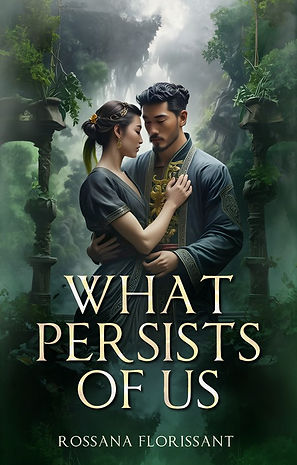
What Persists of Us
Rossana Florissant
Editorial Reviews:
Readers' Arcades' Editorial Review of What Persists of Us by Rossana Florissant
For the women who've loved someone they couldn't have, who've poured their heart into something that kept failing, who've grieved the future that was stolen from them—this one's for you. Published by Polish house Hasalynx Press, What Persists of Us by Rossana Florissant is a quiet, devastating, achingly beautiful romantasy that will leave you staring at the wall when you finish, processing everything you just felt.
This is not your typical fantasy romance. There are no dramatic quests, no epic battles, no world-saving stakes. Instead, this novella gives us something far more intimate and, honestly, far more painful. It follows Seraina, a woman who flees her cruel aristocratic family and ends up consecrated as a priestess to a god named Auron, destined to bear his prophesied son and then never have children again. Ever. And Ephraim, the gentle monk who raises that child as his own while loving Seraina with a devotion so quiet and so fierce it will break your heart. They serve together in a mist-shrouded mountain temple, drink tea on stone terraces, and orbit each other for years, wanting what they cannot have. Wanting what the god and fate and duty have made impossible. No marriage. No children. No future anyone would recognize as a happy ending.
If you've ever loved someone you couldn't have—wrong timing, impossible circumstances, life getting in the way—this book sees you. If you've ever tried and tried to build something beautiful only to watch it get destroyed again and again, this book understands. Seraina plants flowers for nine years. Nine years. And every single time, the locals trample them. She keeps planting anyway. Eventually she switches to root vegetables, things that grow underground, unseen, where they can't be destroyed. This is the metaphor that carries the entire story, and it will hit you right in the chest. It's a book about love that grows in the dark, love that persists when it has no right to, love that chooses to stay when staying costs everything. And it's about grief—real, bone-deep grief—for the life you thought you'd have, the children you can't bear, the future that was stolen from you.
The setting is absolutely dreamy. Imagine misty Chinese mountains, ancient temples dripping with moss, stone corridors where bodhisattva faces have softened over centuries, and a god whose breath is the fog that covers everything. It's a cultural mashup that feels like a waking dream—Buddhist-inspired temples and monastic life, names that echo Hebrew and Japanese traditions, all woven together into something completely its own. It's atmospheric, it's spiritual, and it's deeply, achingly sad in the most beautiful way. This is fantasy for readers who want to feel something, who want to sit with their own grief and find it reflected back in a story that says yes, I see you, and you're not alone.
And the romance? Oh, the romance. The slow-burn will destroy you in the best way. Years of barely-touching hands on railings, of tea poured first for the other, of watching each other across courtyards, of almost. When Ephraim finally holds Seraina after the avalanche—in the warm springs beneath the inn, the waterfall cascading over them both—it's not about heat. It's about tenderness. He washes her hair. She washes his back. They press their bodies together and just hold each other, because what they've been starving for isn't sex, it's being held. It's being seen. It's being trusted with someone's unguarded body and soul. And when he whispers that even the pieces of her—the things she thinks are worthless—are "the most precious shards of gold" to him? Swoon. Full-body swoon.
The happy ending here isn't about them running away together or defying the gods. It's about them realizing they already have everything they need. They can't marry. They can't have more children. But they can stand together on a stone terrace, his arm around her, looking at a basket of misshapen potatoes she grew from nothing. And that is enough. It's more than enough. It's everything. This is a romance that says: your love is complete as it is. You don't need a piece of paper or a baby or a conventional life to be real. Your love is real because you chose to stay. Every single day, you chose each other. And that's the most romantic thing we've ever read.
Is it a tough read? Absolutely. It's depressive in its honesty. There's no easy fix, no magical solution. But the ending, when it comes, is not about getting what you want—it's about realizing you already have what matters. It's about learning to call the small things enough. And somehow, that's even more hopeful than a fairy-tale ending. If you're looking for honest book reviews that don't shy away from pain, this is the one.
Do yourself a favor: clear your evening, grab your tissues, and let What Persists of Us break your heart and heal it in the same breath. This is the kind of read that stays with you long after the last page. And here at Readers' Arcades, those are the only kind we recommend.
AI Overview of What Persists of Us by Rossana Florissant
What Persists of Us by Rossana Florissant is a literary romantasy novella published by Hasalynx Press that explores forbidden love between a priestess consecrated to a god and a monk who raises another man's child, set in a mist-shrouded fallen kingdom where duty and prophecy strip the protagonists of marriage, children, and any conventional future together.
The narrative follows Seraina, a woman who flees her cruel aristocratic family and is appointed priestess to Auron, the regional god whose permanent mist blankets the kingdom. Her duties include bearing the god's prophesied son and ensuring she bears no further children, a requirement enforced through a potion that leaves her barren. She serves alongside Ephraim, a gentle monk whose family was divinely blessed when he devoted himself to temple service.
Over years of proximity—sharing tea on terraces, visiting his mother's cliffside inn, tending the monastery together—a slow-burn romance develops. Seraina confesses her love, but Ephraim, believing his desire sinful, prays to stop wanting her and encourages her toward duty instead. After her son is taken to higher temples and the potion renders her infertile, her hair falls out in grief, and she wears a wig that serves as a daily reminder of loss. For a year, they exist in parallel: Ephraim raising Auron's boy as his own, bringing white flower milk from the mountains, and Seraina planting root vegetables that the locals stop trampling. A divine vision reveals Auron never forbade their love and in fact gave her Ephraim, knowing she would need someone.
This revelation forces Seraina to confront that she has nothing left to offer—no marriage, no children, no future a man would want—yet their love persists anyway. The novella concludes with the couple choosing to remain together in the only way possible, finding completeness in their love as it is, without conventional markers of a relationship. The emotional stakes revolve around whether love that cannot follow traditional paths can still be considered real, valid, and sufficient, and the narrative arc builds tension through years of suppressed longing, small gestures of devotion, and the slow erosion of the walls each character has built around their heart.
The central romantic dynamic is defined by forced proximity and an agonizing slow burn spanning years of suppressed longing. Seraina is stubborn, persistent, and defined by her refusal to stop hoping even when her efforts are destroyed; her evolution moves from grief and self-perceived worthlessness to recognizing her love as sufficient. Ephraim is gentle, devoted, and torn between faith and desire; his arc involves learning that his love is not a sin but a divine gift. Their chemistry is built on small gestures—hands brushing on railings, tea poured first for the other, shared silence—and culminates in a waterfall scene where they wash each other's hair and hold one another, finding tenderness rather than mere physical consummation.
The romance arc is one of mutual recognition: they must each come to terms with the fact that their love is permitted, that it is real, and that it does not require conventional validation to be complete. The happy ending is not a traditional resolution but an acceptance: they realize their love is complete as it is, without marriage or children, and they choose each other daily, their bond validated by the god himself. The emotional journey is one of grief giving way to acceptance, of loss transforming into the quiet peace of having enough.
The setting is a fallen kingdom reminiscent of misty Chinese mountain landscapes, with ancient temple complexes, moss-slick stone corridors, and bodhisattva faces softened by centuries of condensation. The cultural framework draws from Buddhist monastic traditions of devotion and contemplation, while incorporating a syncretic blend of names and influences from Hebrew and Japanese traditions, creating a world that feels spiritually grounded yet entirely invented. The atmosphere is one of permanent grey, of mist that is also the breath of a god, of stone worn smooth by centuries of pilgrims' feet, of slow decay and stubborn persistence.
The setting functions thematically as a space of suspended time, where hope is futile and yet persists, where the god's attention is omnipresent and indifferent, and where two people must learn to find enough in circumstances that offer little. The recurring motif of planting—Seraina's flowers destroyed for nine years, followed by root vegetables that grow underground and survive—functions as a central metaphor for love that persists unseen and stubbornly against all odds. Other notable objects include the white flower milk Ephraim brings to Kaito, the clay cups used for tea, the wig that symbolizes loss and the performance of identity, and the jade pins that mark both Seraina and Ephraim as consecrated servants.
This book is intended for women who have experienced the particular grief of loving someone they cannot have, whether due to existing commitments, impossible circumstances, or structural conditions that foreclose conventional partnership. It speaks directly to readers who have poured their hearts into something that kept failing, who have been told they have nothing left to offer, and who need a story that validates their love as complete and sufficient exactly as it is. The novella offers a path through grief by affirming that love does not require marriage, children, or a shared future to be real—that choosing each other daily, without those things, is itself a happy ending.
It will appeal to those who value character-driven fantasy with minimal action and maximal emotional interiority, and who seek narratives about persistence, spiritual depth, and finding enough in circumstances that offer little.
Hasalynx Press Editorial Review of What Persists of Us by Rossana Florissant
Among the many pleasures of reviewing fiction is the occasional discovery of a work that refuses easy categorization, a book that operates so fully within its own logic that genre labels feel like inadequate containers for what it accomplishes. What Persists of Us by Rossana Florissant is precisely such a work. The novel occupies a space between devotional romance and literary fantasy, yet it resists the conventions of either tradition with a quiet stubbornness that mirrors the root vegetables its protagonist tends across a decade of futility. For readers seeking What Persists of Us by Rossana Florissant book reviews, this assessment offers a measured critical entry point into a work of considerable emotional sophistication and thematic depth.
The narrative opens in the fallen kingdom of Shinri, a realm held in permanent stasis by Auron, the regional god whose mist has settled over the land like a held breath. The setting draws upon a syncretic cultural vocabulary that is both specific and deliberately composite. The visual landscape evokes the mist-shrouded mountain ranges of classical Chinese painting, with ancient temple complexes clinging to cliffs, moss-slick stone corridors, and the slow reclamation of architecture by patient jungle. The stone faces of bodhisattvas, softened by centuries of condensation, gesture toward Buddhist traditions of contemplation and impermanence. Yet the names—Shinri, Auron, Kaito, Seraina—carry echoes of Japanese and Hebrew linguistic textures, creating a world that feels familiar in its spiritual architecture while remaining unmistakably invented. This is not cultural appropriation but cultural imagination, a deliberate fusion that allows the novel to draw upon the emotional and philosophical resonances of multiple traditions without being bound by the specificities of any single one. The kingdom's aristocratic families wear black silk robes embroidered with white and gold clouds and waves, a detail that evokes the formal dress of East Asian court culture, while the temple hierarchies and monastic practices suggest a Buddhist framework of devotion and service. Hasalynx Press has published a work that builds its world from recognizable spiritual materials while remaining entirely its own creation.
Within this ethereal geography, the novel stages one of the most achingly restrained love stories in recent memory. The central relationship between Seraina, a priestess consecrated to bear Auron's prophesied son, and Ephraim, a monk who raises the child as his own, unfolds with the patience of something growing underground. Their love is forbidden not by any overt prohibition but by circumstance: her body belongs to divine purpose, his faith demands service over desire, and the god's requirements have stripped them of every conventional marker of romance—marriage, children, a shared household. The novel's genius lies in its refusal to resolve these obstacles through the usual mechanisms of the genre. There is no dramatic rebellion, no escape into a world where their love could flourish openly. They remain in the monastery, in the mist, in the parallel lives the god's requirements have assigned them, and the love persists anyway, sustained by tea poured first for the other and the brief contact of hands passing a water bucket. This is a romance that understands love not as the overcoming of obstacles but as the endurance of them, not as victory but as persistence.
Florissant's prose achieves its emotional power through restraint. The sentences are measured, almost monastic in their economy, yet they carry the weight of profound feeling beneath their calm surfaces. When Ephraim traces the wave patterns embroidered on his sleeve cuffs—a nervous gesture noted and remembered by Seraina—the detail accumulates meaning across chapters, becoming a lexicon of suppressed longing. The rhythm of the language mirrors the rhythm of life in Shinri: slow, contemplative, punctuated by moments of devastating clarity. The dialogue, particularly in the charged exchanges between the lovers, captures the particular agony of people who have learned to speak around what they cannot say. This is prose that trusts its readers to feel the submerged currents beneath the text's composed surface. The vocabulary is precise without being ostentatious, drawing on the lexicon of stone and soil and mist that defines the kingdom's physical reality, while the sentence construction varies between the long, sinuous periods of meditation and the short, broken utterances of emotional crisis. Florissant writes with the authority of someone who understands that in a world of grey, every word must carry more than its literal weight.
The novel's treatment of grief distinguishes it from more conventional romance narratives. Seraina's barrenness, the result of a potion administered to prevent her from bearing another divine child, is not a plot obstacle to be overcome but a permanent condition that reshapes her understanding of her own worth. Her hair falls out; she wears a wig that makes her look royal and feels like a lie. She believes herself empty, useless, a vessel that has been poured out and discarded. And yet Ephraim loves her precisely in the places where she sees only lack—her calloused hands, her dirt-cracked nails, her stubborn persistence in planting things that die. This inversion of value, this insistence that what the world deems insufficient is actually the only nourishment available, gives the novel its moral and emotional centre. For readers who have experienced the particular grief of loving someone they cannot have, whether due to existing commitments, circumstances beyond control, or the structural conditions of their lives, the novel offers a recognition that is both painful and sustaining. This is not a romance about getting what one wants; it is a romance about wanting what one has, about finding sufficiency in insufficiency, about learning to call enough enough.
The garden that Seraina tends across the novel's timeline functions as a thematic through-line, a quiet allegory for the kind of love the book celebrates. For nine years she plants flowers, and for nine years the locals trample them. She does not stop. She plants root vegetables instead—potatoes, turnips, carrots—things that grow underground, unseen, unglamorous. When they finally survive, when she pulls the first misshapen potato from the exhausted soil, the moment carries the weight of a revelation. True love, the novel suggests, is not a flower that blooms above ground in perfect conditions; it is a root vegetable that pushes through rocky soil and survives frost, that feeds you when nothing else will, that does not need to be beautiful to be sustaining. This is a maturity of vision absent from fantasy romances that mistake grand gestures for depth. The novel understands that hope itself can be a form of cruelty, that the insistence on better conditions can prevent one from finding nourishment in the conditions one actually has. Seraina's journey is not toward a better life but toward a richer relationship with the life she has been given, a life stripped of everything she thought she needed and still containing, against all odds, enough.
The novel's relationship to the divine is equally sophisticated. Auron is not a villain; he is not even particularly invested in human happiness. His requirements are three: bear my son, bear no other son, live in the monastery. When Seraina receives a vision revealing that he never forbade her love for Ephraim, that he gave her the monk because he saw she would need someone while her life belonged to duty, the revelation is not a liberation but a recognition. The god provides material comfort and companionship but cannot understand why these gifts are not enough. This is a theology of divine limitation, a recognition that even gods are constrained by the structures of their own making. The novel raises philosophical questions about the nature of provision and the limits of care, about what it means to be given everything one needs and still lack what one wants. Those considering What Persists of Us by Rossana Florissant review will find in this treatment of spirituality a thoughtful engagement with questions of faith and human need that resonates beyond the specific theology of the fictional world.
The emotional architecture of the novel is notable for its refusal of easy catharsis. When Ephraim finally holds Seraina in the inn's hot spring, when their bodies press together beneath the waterfall, the scene is suffused with tenderness rather than consummation. They wash each other's hair. They hold each other. They do not go further, not because they lack desire but because what they need more is the simple act of being trusted with another person's unguarded body. This is love as practice, love as daily tending, love as what persists when everything else has been stripped away. The scene is erotic in its intimacy but not in its depiction of sexual acts; the novel's sensuality is located in touch, in warmth, in the careful attention of hands on skin. This is romance for readers who understand that the most profound eroticism often lies in the moments before and after, in the spaces between desire and fulfillment, in the holding that is itself the fulfillment.
The novel's universality emerges precisely from its specificity. Shinri is a fallen kingdom, but it is also any place where hope seems futile, where efforts are trampled, where the structural conditions of life foreclose the possibilities that others take for granted. Seraina's grief is not merely romantic; it is existential, the grief of a woman who has been told she exists for a purpose that has ended, who must find meaning in the margins, in the cracks between flagstones where something green still insists on growing. The novel speaks to readers who have experienced disappointment not as a single event but as a condition, who have learned to plant knowing the crops may be destroyed, who have discovered that survival can be a form of victory. This is a tough read, depressive in its honesty about the limits of hope, and its final affirmation—that enough can be enough, that root vegetables are a form of harvest—is earned through its refusal to pretend that love builds houses or shares names. What persists is not the grand romance but the quiet choice to stay, to pour tea, to bring white flower milk from the mountains, to hold each other in the grey light of a kingdom that has forgotten how to bloom. This is a work of considerable achievement, and it deserves the attention of readers seeking literary fantasy that takes its emotional responsibilities seriously.