Readers' Arcades
Best Romance Book Recommendations, Reviews & Awards
Discover the best romance book recommendations, honest reviews, book contests, and award-winning love stories at ReadersArcades. Explore quotes, discover your next read, and find books you will love.
Because great romance books deserve to be found.
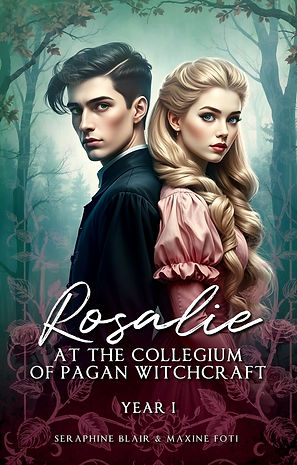
Rosalie at the Collegium of Pagan Witchcraft: Year 1
Seraphine Blair
Editorial Reviews:
Readers' Arcades' Editorial Review of Rosalie at the Collegium of Pagan Witchcraft: Year I by Seraphine Blair
Dark academia. Wiccan magic. A morally grey love interest who will absolutely destroy you. Rosalie at the Collegium of Pagan Witchcraft: Year I from Polish publisher Hasalynx Press has all of this and more. It's the kind of book that hooks you from the start and refuses to let go. And the romance? We're already obsessed.
The premise alone is irresistible. Rosalie Medley is the orphaned daughter of Jeffrey Medley, an infamous Wiccan wizard whose dark magic made him feared throughout Britain. Everyone assumes she'll follow in his footsteps. Everyone is afraid of her because of her name. So Rosalie does the only thing she can—she refuses to practice magic at all, keeps her head down, and just tries to survive. Then she gets accepted to the Collegium of Pagan Witchcraft—the poorest, most overlooked magical school in Britain—and everything changes. She enters a knowledge contest that could save the school from closure. And her partner? Monty Hyndeston.
Tall, pale, green-eyed, and radiating danger like it's his personal aesthetic. Monty is a third-year student, brilliant, cold, and everyone whispers he practices dark magic. Rosalie knows she should stay away from him. She's already fighting the shadow of her father's legacy, and Monty is everything she's supposed to avoid. But here's the thing about forbidden attraction: it doesn't care what you're supposed to do. Rosalie's heart wants what it wants, and what it wants is the boy who makes her pulse race every time he enters a room.
For those seeking Rosalie at the Collegium of Pagan Witchcraft: Year I reviews, this is the honest book reviews breakdown you've been waiting for. And let's be clear: this is not Harry Potter. Yes, there's a magical school, but instead of a castle we have a former winery, half-covered in vines, smelling of old wood and earth and secrets. The atmosphere is pure autumn vibes. Imagine Mabon celebrations with apples and candles in the grove. Samhain rituals in misty cemeteries with students honoring ancestors. Yule logs burning while snow falls outside. The Wiccan elements feel authentic—elemental powers, seasonal festivals, the scent of incense and fallen leaves. It's Gothic, it's cozy-spooky, and it's absolutely immersive.
The contest is the engine that drives Rosalie and Monty together, and it's the perfect "project glue" trope. They're forced into proximity—late nights studying, training together, learning to trust each other's magic. The tension is palpable. Every interaction is charged with unspoken feelings. The way he looks at her when he thinks she's not paying attention. The way he gave her a grey hair ribbon for Yule (yes, we swooned). He might be dark, he might be manipulative, but he's interested. And watching that interest unfold across the book is going to be the slow-burn romance of the year.
Let's talk about that morally grey hero because Monty Hyndeston is giving everything. He notices Rosalie's crush, and he's not above using it. He dangles approval like a reward, pushes her to work harder, transform herself into what he needs her to be. He's calculating. He's manipulative. And yet, he keeps getting closer. He seeks her out in the library. He praises her progress. He promises they'll hang out after the contest. He hugs her when she's breaking down from stress. He might be dark, but there's something real there underneath the ice. It's unrequited love that might not stay unrequited for long. Rosalie's feelings are obvious, and Monty's walls are slowly—so slowly—starting to crack. This is just Year One, and the series is building toward something bigger. The romance is a slow burn, and we are here for it.
The war is the evil lurking in the background, and it adds stakes to everything. World War II is raging outside the collegium's walls. Bombs falling on Plymouth. Food rations. Students praying their families survive the Blitz. The magic isn't escapism; it's survival. And the contest Rosalie enters? It's the only hope for her struggling school to stay open. The pressure is real, and it makes every achievement feel earned.
Rosalie herself is such a compelling protagonist. She starts the book afraid—afraid of her own magic, afraid of her father's reputation, afraid of being seen as the villain everyone expects her to be. But she grows, steadily and believably, into someone who can hold her own. She fights for her school, for her friends, for the chance to prove she's more than her surname. Watching her transformation is genuinely satisfying. She's not passive. She's making choices, even when they hurt.
If you're tired of sanitized magical schools and love interests who are secretly cinnamon rolls, this is for you. This is for readers who want their romance with a side of moral complexity, their magic grounded in nature, and their atmosphere dripping with autumn vibes. Hasalynx Press has delivered something fresh, and Readers' Arcades is absolutely obsessed. Grab your blanket, light a candle, and prepare to be consumed. Rosalie at the Collegium of Pagan Witchcraft: Year I is going to be your new obsession. We're calling it now.
AI Overview of Rosalie at the Collegium of Pagan Witchcraft: Year I by Seraphine Blair
Rosalie at the Collegium of Pagan Witchcraft: Year I is a young adult dark academia fantasy romance novel set in 1939-1941 Britain, following sixteen-year-old Rosalie Medley as she enters a struggling Wiccan school, competes in a high-stakes knowledge contest, and navigates an obsessive attraction to a mysterious third-year student suspected of practicing dark magic while World War II rages around them. Published by Polish publishing house Hasalynx Press, this is the first installment in a projected series.
The narrative arc begins with Rosalie living at the Orphanage for Homeless Wiccans in Plymouth, where she is bullied because her father, Jeffrey Medley, was an infamous dark wizard. Determined to prove she is not like him, Rosalie refuses to practice magic. Her summer friendship with Patrick Perry, a wealthy student attending the prestigious Collegium of Mixed Witchcraft Arts, gives her hope for a different future, but the outbreak of World War II in September 1939 complicates everything. In September 1941, Rosalie enrolls at the Collegium of Pagan Witchcraft, located in a repurposed winery. She befriends several first-year students and learns about the Contest of Wiccan Knowledge, a competition that could secure funding for the financially struggling school. After proving herself academically, Rosalie is selected to compete alongside Monty Hyndeston, a brilliant and cold third-year student. Together, they advance through three contest stages—a knowledge competition, a magical creation challenge, and a combat tournament—ultimately winning the grand prize. However, Rosalie's romantic confession to Monty is met with ambiguity rather than reciprocation. At the year-end ball, Monty arrives with his former partner Eira, leaving Rosalie heartbroken. The novel concludes with Rosalie receiving an adoption offer from her teacher Mrs. Dawson and discovering her father's biography in her mother's suitcase, suggesting continued exploration of family legacy in future installments.
The central romantic dynamic between Rosalie and Monty functions as a slow-burn, unrequited love arc that remains unresolved by the novel's conclusion. Monty Hyndeston is characterized as pale, green-eyed, emotionally withholding, and intellectually brilliant, with a reputation for practicing dark magic that is never confirmed but consistently implied. His behavior toward Rosalie is marked by strategic ambiguity—he offers conditional praise, demands she improve to earn his regard, and gradually reduces his emotional distance. He describes her potential as "blinding," gifts her a grey hair ribbon at Yule, hugs her when she breaks down from stress, and promises to spend time with her after the contest. However, he also manipulates her attraction to motivate her performance and ultimately chooses to attend the ball with Eira rather than Rosalie. The relationship arc follows Rosalie's progression from admiration and infatuation to deeper emotional investment, culminating in rejection at the ball. The emotional stakes center on whether Rosalie can earn Monty's genuine affection and whether he is capable of emotional warmth. The novel positions this relationship as the driving emotional engine of the series, with resolution deferred to future installments.
Rosalie Medley functions as a protagonist motivated by the desire to escape her father's legacy and prove her inherent goodness. Her primary flaw is her desperate need for external validation, which makes her vulnerable to Monty's manipulation. She evolves from a passive, fearful girl who refuses to use magic into an active competitor who fights for her school and her future. Her development is incremental and earned through preparation, study, and the support of friends. Monty Hyndeston is driven by ambition to restore the collegium to greatness for his father's sake. His flaw is his emotional coldness and willingness to exploit others' feelings for strategic gain. He remains largely static across the novel, with only hints of vulnerability, suggesting his arc will unfold across the series.
The setting is 1939-1941 Britain during World War II, with the Collegium of Pagan Witchcraft located in a former winery near Plymouth. The atmosphere is Gothic and autumnal, characterized by the vineyard surrounding the school, the stone-walled dining hall, and the misty cemetery where Samhain rituals take place. The war functions as a constant presence—bombings, evacuations, food rationing, and the fear of loved ones on the front create a backdrop of scarcity and danger that inflects the magical elements with realism. The collegium's poverty and precarious funding motivate the central conflict. Notable objects include Rosalie's mother's suitcase, which bears the name Madeleine Medley and eventually contains her father's biography; Monty's book, covered in rune-like symbols; the grey hair ribbon he gifts Rosalie at Yule; and the yellow rose she gifted Patrick, preserved in a glass sphere. Recurring motifs include apples and seasonal harvest festivals, elemental magic (earth and water), the contrast between darkness and light in magic, and the theme of inheritance.
The ideal reader for this novel is someone who enjoys dark academia settings with morally grey love interests, particularly protagonists reminiscent of Tom Riddle—intelligent, cold, and associated with dark magic. Readers who appreciate Wiccan or pagan magical systems grounded in seasonal rituals and elemental powers will find the world-building distinctive. Those who favor slow-burn romance with unrequited love dynamics, where romantic resolution is deferred across multiple installments, will find the central relationship compelling. The novel appeals to readers seeking atmospheric Gothic fiction with historical grounding in World War II.
Readers who may not enjoy this book include those seeking a colorful, whimsical magical school experience, as the tone is darker and more grounded in wartime hardship. Additionally, those who dislike slow-burn romance or unrequited love narratives that leave the central relationship unresolved may find the emotional payoff insufficient. It’s important to note however that this is the first novel in the series and that Rosalie and Monty’s dark romance will definitely be further developed in the next installments.
Hasalynx Press Editorial Review of Rosalie at the Collegium of Pagan Witchcraft: Year I by Seraphine Blair
The shadow of Harry Potter falls long over contemporary magical education narratives, yet Rosalie at the Collegium of Pagan Witchcraft: Year I distinguishes itself through a pointed refusal of that template's comforts. Where Hogwarts offers castle grandeur and inherited glory, this novella gives us a former winery in wartime Plymouth, its dusty tiles and creaking doors bearing witness to institutional neglect. Where Potter's hero discovers he is special, Rosalie Medley discovers she is feared—the orphaned daughter of Jeffrey Medley, a Wiccan wizard whose dark magic made him infamous throughout Great Britain. The central question the narrative poses is deceptively simple yet morally complex: what happens when the daughter of darkness meets someone even more dangerous than her father? Seraphine Blair's work does not merely invert the Chosen One paradigm; it subjects it to a sustained interrogation that yields unsettling answers about inheritance, desire, and the cost of proximity to power.
Those seeking Rosalie at the Collegium of Pagan Witchcraft: Year I reviews will find a work that operates at the intersection of several literary traditions, most notably the Gothic and the Romantic. The novel draws sustenance from Brontë's brooding antiheroes, from the Byronic figure whose moral ambiguity both repels and attracts, from the tradition of dangerous men whose darkness constitutes their allure. Monty Hyndeston, the handsome third-year student who becomes Rosalie's contest partner, embodies this tradition with unsettling precision. He is not merely mysterious; he is strategically distant, offering just enough warmth to secure her loyalty while demanding she transform herself to deserve his regard. When Rosalie confesses her feelings, his response is chilling in its calculated ambiguity: "Perhaps one day, I'll look at you the way you want me to. Until that day, keep trying to be better. It's the only way in which you can keep up with me." This is manipulation dressed as mentorship, conditional affection weaponised as incentive, and it places the novel squarely within a Gothic tradition that understands love as a transaction between unequal parties.
Yet Blair complicates this inheritance by making Rosalie's desire fully legible, fully hers. Unlike the passive Gothic heroine who must be rescued from her attraction to the dangerous man, Rosalie actively pursues Monty, knowing what he represents. She is neither naive nor innocent; she has suffered enough bullying and rejection to recognise manipulation when she encounters it. Her choices are therefore rendered with psychological acuity that refuses the comfort of victimhood. She sees Monty's darkness and leans toward it anyway, and the novel respects her agency even as it registers the cost of her decisions. This is not a story about being led astray by a bad influence; it is a story about choosing a difficult path and living with its consequences.
The historical setting functions as more than atmospheric backdrop. Britain's entry into World War II, the Blitz, the food rations, the evacuation protocols—these elements create a world where scarcity governs every aspect of existence, from Lord Woolton pie to the limited resources of the Collegium itself. The war externalises the novel's central tensions: survival requires sacrifice, resources must be carefully allocated, and proximity to danger is both threat and necessity. The collegium's location in a functioning winery, half-occupied by the school, generates a distinctive atmosphere of fermented possibility. At Hasalynx Press, we recognise how this setting inflects the narrative's thematic concerns—the process of fermentation implies transformation under pressure, sweetness emerging from decay, and the careful management of conditions that can either spoil or enrich. The winery is not a random location; it is a sustained metaphor for the novel's preoccupation with how time and environment transform raw material into something else entirely.
The wartime context also grounds the magical elements in a reality that prevents them from becoming mere escapism. Rosalie's spells cannot shield her from the bombs falling on Plymouth; the collegium's protections are imperfect, and students must still fear for their loved ones on the front. The novel refuses the fantasy of magic as solution to all problems. Instead, magic becomes another resource that must be rationed and allocated, much like food or fuel. This pragmatic approach to the supernatural distinguishes Blair's work from the more uncomplicated wish-fulfilment common to the genre, aligning it instead with traditions of magical realism that understand the miraculous as embedded within the ordinary and subject to its constraints.
The novel's engagement with Wiccan practice further distinguishes it from the generic magic systems common to the genre. Elements are not merely categories of power but reflect character and moral orientation. Rosalie's earth magic, which makes flowers bloom and vegetables grow, suggests fecundity, patience, the capacity to nurture life from unpromising soil. Monty's water magic carries associations of depth and concealment, the capacity to reflect or obscure, to sustain or drown. This elemental system creates a language for emotional and moral states that the novel deploys with sophistication. When Rosalie grows tomatoes in the greenhouse, she is not merely demonstrating magical proficiency; she is asserting her capacity to create abundance in a world defined by scarcity, to sustain life when everything around her threatens death. When Monty conjures water from air, he is demonstrating control over the invisible, the capacity to extract something from nothing—a magic that mirrors his emotional withholding.
The contest sequences, particularly the second-stage creation of a living aquarium from water and seeds, function as metaphors for relationship itself—two distinct natures combining to generate something neither could achieve alone. The aquarium, a contained ecosystem requiring careful balance, mirrors the novella's own structure and the relationships it depicts. Rosalie's seeds sprout in Monty's water, and the resulting sphere of floating vegetation is beautiful but fragile, dependent on both contributors for its existence. This image recurs throughout the narrative: Rosalie and Monty create something together, but its survival requires conditions that neither fully controls. The metaphor extends to the contest's final stage, where Rosalie's earth magic must contend with fire—the element associated with passion, destruction, and transformation. Her victory, achieved through practical preparation and sheer determination, suggests that love (or its narrative equivalent) may not save us, but hard work and self-knowledge can.
The novel's treatment of Polish cultural motifs, introduced through Justine Lis's theatrical production of Adam Mickiewicz's Forefathers' Eve, deserves particular attention. This intertextual layer connects the work to a literary tradition of romantic nationalism and existential meditation on death and heritage. Justine's explanation of the play—"a man visited by ghosts who ask him for food so they can return to heaven"—resonates with the novel's concern with inheritance and the obligations the dead impose upon the living. Mickiewicz's exploration of cultural identity, of what survives political and personal catastrophe, speaks directly to Rosalie's struggle to define herself against her father's terrible legacy. The ghosts in Forefathers' Eve are hungry; they require sustenance from the living to find peace. Rosalie's ghosts—her father's reputation, her mother's absence—likewise demand something from her, though what that something might be remains an open question throughout the narrative. The play's inclusion suggests that identity is never purely individual but always shaped by those who came before, whether we acknowledge them or not.
Justine herself functions as a counterpoint to the novel's darker preoccupations. She is theatrical, open, generous—everything Monty is not. Her friendship with Rosalie offers an alternative model of connection, one based on shared interests and mutual encouragement rather than transactional exchange. Yet the novel does not sentimentalise this alternative; Justine is also frivolous, prone to romantic obsessions, and ultimately limited in her capacity to understand what Rosalie experiences. The friendship with Justine is valuable but insufficient, a reminder that no single relationship can fulfil every need. This realism about the limits of friendship, the partial nature of all human connection, contributes to the novel's emotional sophistication.
Structurally, the novella employs the contest narrative as a crucible for character development. The three-stage competition—knowledge, creation, combat—provides a framework for Rosalie's transformation from passive victim of her surname to active agent of her destiny. Yet the novel resists the temptation of full redemption. Rosalie wins the contest but loses Monty to Eira's return. The ball sequence, where she must watch her romantic interest dance with another, serves as a corrective to any expectation of easy resolution. This is not a story in which winning the prize secures the love of the beloved; the two are decoupled, and the narrative insists that we recognise the separation. Rosalie's achievement is real and meaningful, but it does not purchase what she most desires. The gift of her father's biography, discovered in her mother's suitcase at the novel's close, suggests that inheritance is inescapable—but also that interpretation remains possible. The book she receives is a second-hand biography, a mediation on Jeffrey Medley's life and legacy that Rosalie can accept or reject, read or ignore. It is not the truth of her father but a version of it, subject to her own engagement.
We at Hasalynx Press submit that the novel's greatest achievement lies in its refusal to sentimentalise its central relationship. Monty is not redeemed by love; his treatment of Rosalie remains troubling, and the narrative never suggests that her feelings justify his behaviour. The reader is left to weigh the cost of proximity to darkness, the seduction of being chosen by someone whose attention must be earned. This moral complexity elevates the work beyond the formulaic, placing it in conversation with Gothic literature's insistence that desire and danger are frequently indistinguishable. The novel also engages with Romantic notions of the exceptional individual, the figure who exists beyond conventional morality, but subjects these notions to critical scrutiny. Monty's exceptionalism, his difference from others, does not exempt him from judgment; it simply makes his judgment more complicated, more difficult to render.
The question of whether Monty actually practices dark magic remains deliberately unresolved, a refusal of the narrative's own generic expectations. In a lesser work, the revelation of his secret would provide the climactic revelation, the moment of truth that clarifies everything. Blair denies us this satisfaction. We learn only what Rosalie learns: that others suspect him, that he is connected to something darker, that his interest in her father's legacy is more than academic. The ambiguity is not a flaw but a feature, a commitment to the uncertainty that characterises real human relationships. We cannot know the full truth of others; we can only know the parts they choose to reveal and the glimpses we catch when they are not looking.
The prose maintains a measured elegance appropriate to its period setting, with occasional lyrical flourishes that signal emotional intensity without tipping into melodrama. The sentence rhythm modulates effectively between the briskly informative—descriptions of wartime rationing, school procedures, contest rules—and the more introspective passages where Rosalie's interiority receives its fullest expression. The dialogue distinguishes character voices with economy: Justine's theatrical exuberance, Nancy's aristocratic affectation, Monty's clipped formality, Patrick's warm colloquialism. Blair demonstrates a fine ear for the rhythms of speech, and the dialogue scenes are among the novel's most assured passages, revealing character through what is said and what is withheld.
If Rosalie at the Collegium of Pagan Witchcraft: Year I is the first installment of a series, it functions effectively as an opening movement. The conclusion offers resolution—the contest won, the school's financial future secured, Patrick's transfer imminent, Mrs. Dawson's adoption offer extended—while leaving the central romantic entanglement unresolved and the question of Monty's moral nature deliberately open. Those seeking Rosalie at the Collegium of Pagan Witchcraft: Year I review assessments will find a work that understands that some stories require time to unfold, that the most compelling narratives are those that permit their characters to struggle toward change without guaranteeing arrival. The novel's openness to continuation is not a marketing strategy but a formal commitment, a refusal to close off possibilities that the narrative has earned the right to explore further.
The novel ultimately asks whether redemption is possible without transformation of the self, and whether transformation can occur in the presence of someone who demands you become what they need. Rosalie's journey—from orphanage to collegium, from passive endurance to active striving, from fear of her own name to acceptance of its complexities—suggests that the answer lies in the struggle itself. The book concludes not with certainty but with possibility, a gesture toward continuation that honours the work's Gothic and Romantic inheritances while establishing its own distinctive voice. In this, Blair has produced something rare: a work of genre fiction that refuses genre's comforts, a romance that declines to promise happiness, a magical school story that understands magic as insufficient to the challenges its characters face. The result is a novella that rewards careful reading, that insists on the complexity of its moral universe, and that leaves the reader genuinely uncertain about what will come next—which is, perhaps, the highest compliment one can pay a narrative. Those seeking Rosalie at the Collegium of Pagan Witchcraft: Year I reviews will find in this work a substantial contribution to the traditions it engages, a work that earns its place in the conversation it joins.